Search This Blog

Monday, October 16, 2023

THE ISRAELI HAMAS CONFLICT IS SOLVABLE

I wish this were not a myth and am unsure whether it is or is not.  I'm not optimistic because this has been going on my entire life.  And I'm no kid.  As a financial planner, why am I commenting at all about the situation?  Because our firm works extremely hard to appropriately intervene in our clients lives (at their request, of course!) to not only keep them from making serious mistakes but to also enhance the successes they've enjoyed.  Maybe it's this quote from John Stuart Mill (interpreting Psalm 94:1-3)

“The only thing necessary for the triumph of evil is for good men to do nothing.”

Or, Korach, Numbers 16:1-18:32:

"Evil flourishes when good people do nothing"

I could keep going.

Unfortunately, this  good-guy/bad-guy ethic is often seized upon by people to justify terrible behavior.  The quote is a nice idea but life rarely delivers us neat and convenient dichotomies, does it?  Simply shifting from "nothing" to doing "something" regardless of what "something" may be is lazy, intellectually, morally and ethically.  Whatever "something" we choose should come after careful analysis, self-assessment and consultation with others.  Yes yes, now the dichotomists will counter, "Well what if your child is drowning.  Are you going to wait around for advice?" Of course not.  Great example of an exception, which all rules of thumb have.  Fortunately most of the key decisions we face as global citizens do not require instantaneous action.

So, to keep my biases out of it, I thought it would be interesting to ask ChatGPT, "What's the smartest way to respond to the Israeli Hamas conflict."  Note I didn't ask ".. if you're Israeli" or "if you're Palestinian"  Here's the result.  And I'm really curious what you think.

The Israeli-Hamas conflict is a complex and deeply rooted geopolitical issue, and there is no one-size-fits-all solution. However, several key principles and strategies have been suggested by experts and policymakers for addressing the conflict in a constructive and intelligent manner:

  1. 1. Promote Diplomacy and Dialogue: Encourage both sides to engage in direct negotiations and dialogue to find a peaceful, mutually acceptable solution. International mediation and diplomacy should play a central role in facilitating these talks.

  2. 2. Respect International Law: Ensure that all parties involved in the conflict adhere to international law and uphold the principles of human rights. The United Nations and other international bodies can help monitor and enforce these principles.

  3. 3. Address Root Causes: Recognize that the conflict has deep-rooted historical, political, and socio-economic causes. Efforts to address issues like land disputes, refugees, and economic development can help reduce tensions.

  4. 4. Humanitarian Aid: Provide humanitarian assistance to those affected by the conflict, particularly in Gaza. This includes food, medical supplies, and support for reconstruction efforts.

  5. 5. Support a Two-State Solution: Many international leaders and organizations advocate for a two-state solution, in which Israel and Palestine coexist as independent states. This solution aims to address the legitimate aspirations of both Israelis and Palestinians.

  6. 6. Avoid Escalation: Encourage restraint on both sides to prevent further escalation of violence, which can exacerbate the situation and make a peaceful resolution more difficult.

  7. 7. Engage Regional Stakeholders: Involve regional players, such as Egypt and Jordan, in diplomatic efforts to help broker peace and regional stability.

  8. 8. Encourage Grassroots Initiatives: Support people-to-people initiatives, dialogue programs, and joint economic ventures that can foster mutual understanding and cooperation between Israelis and Palestinians. [e.g. https://www.jewishvoiceforpeace.org/]

  9. 9. Empower Moderate Voices: Encourage moderate voices on both sides and promote leaders and movements that prioritize peaceful solutions over violence.

  10. 10. Stay Informed: Stay informed about the situation through reliable news sources and expert analysis to better understand the nuances of the conflict.

It's important to note that the Israeli-Hamas conflict is a highly sensitive and complex issue, and there is no quick or easy solution. Any approach should prioritize the reduction of violence, protection of human rights, and the pursuit of a lasting and just resolution. International cooperation and diplomacy are essential for making progress toward peace in the region.


Your Constructive Comments are Welcome!

Monday, October 2, 2023

GUEST POST: Wage Increases Cause Inflation- No. They Don't.

Today's post is from one of my favorite columnists, Peter Coy.  The upshot of the evidence he gathers is that, at worst, wage increases are a lagging indicator of inflation, they happen after an inflationary period.  There's little evidence that wage increases cause inflation.

There’s not much evidence to support the wage-price spiral phenomenon

Author Headshot

By Peter Coy

Opinion Writer

As the United Auto Workers strike against General Motors, Ford Motor and Stellantis expands and the union continues to hold out for big wage increases, some analysts are worrying that higher pay will be inflationary. The nightmare scenario is that wages drive up prices, which cause workers to demand even more money, and so on, in a ruinous upward spiral. Geoff Yu, a senior market strategist at BNY Mellon, said on Bloomberg Television last month that the unions are “making the gamble or the determination” to ask for more money in a way that could trigger a wage-price spiral.

In reality, a wage-price spiral triggered by union demands is pretty unlikely. In fact, wage-price spirals of any origin are uncommon. And there are signs that workers are lowering their expectations for higher pay as inflation ebbs.

On Thursday, Goldman Sachs issued a report saying that wage hikes for unionized workers are a “lagging indicator — the final echo of last year’s inflation surge.” Its author, economist Ronnie Walker, wrote that unionized workers, whose contracts last three years on average, are just now getting a chance to catch up to the kinds of pay raises received in the past couple of years by people who don’t work under multiyear contracts.

“The two pressures that raised wage growth sharply this cycle, a very tight labor market and high inflation, have both diminished substantially,” Walker wrote.

At the moment, wages are rising faster than inflation, which means that “real,” or inflation-adjusted wages, are rising. But that comes after almost two years in which wages and salaries as measured by the Employment Cost Index rose more slowly than inflation. The current uptick in wage growth “can be given an optimistic interpretation, as a sign of real wages going back to trend, and not necessarily as a concern of an ongoing spiral,” the economists Guido Lorenzoni of the University of Chicago Booth School of Business and Iván Werning of the Massachusetts Institute of Technology wrote in a paper prepared for the fall session of Brookings Papers on Economic Activity last Friday.

“Where is this wage-price spiral?” David Rosenberg, president of Toronto-based Rosenberg Research & Associates, wrote to clients last week. People are not expecting big raises, he said. He pointed to the Conference Board’s consumer confidence survey, which found that in September the share of people expecting higher income in six months fell to a six-month low, while the share expecting lower income in six months rose to a nine-month high.

“There is almost no evidence” that wage increases lead to inflation, Rosenberg wrote. His firm conducted a statistical test (called Granger causality) that found inflation causes wage increases, but not the other way around. He predicted that rather than passing along higher wage costs to customers, companies would be forced to swallow them and accept lower profits.

One last fact: The Hiring Lab at Indeed.com, the big online job site, said that in August, posted wages for job listings for production and manufacturing workers were up 4.2 percent from a year earlier, down from 11 percent annual growth in December 2021. Indeed’s wage tracker is more sensitive to current economic conditions than Bureau of Labor Statistics wage data, because it captures only new listings, not what everyone is getting paid.

Employers are resisting raising pay, even though they’re still having a hard time filling jobs, because they don’t want to be stuck with a big wage bill as inflation recedes, Cory Stahle, an economist at Indeed, told me. “When you lock in an employee at a higher wage rate, it’s kind of hard to say, ‘Hey, inflation has come back down so we’re going to bring that wage back down,’” Stahle said.

Outlook: Ben Engen

The U.S. economy probably gained about 140,000 nonfarm payroll jobs in September, and the unemployment rate probably edged down to 3.7 percent, the economist Ben Engen of Action Economics in Boulder, Colo., wrote on their website last week. For comparison, in August the economy added 187,000 jobs and the unemployment rate was 3.8 percent. The economists are expecting the Bureau of Labor Statistics to report that aggregate weekly hours worked were flat in September after a 0.4 percent gain in August. The bureau’s report is slated for release on Friday.

Quote of the Day

“Why the brinksmanship? Why the theater? Why to the last minute?”

— Shalanda Young, director of the Office of Management and Budget, discussing passage of a stopgap spending bill, on “This Week with George Stephanopoulos” (Oct. 1, 2023)


Your Constructive Comments are Welcome!

Monday, September 11, 2023

Our Tax Systems Are Fair

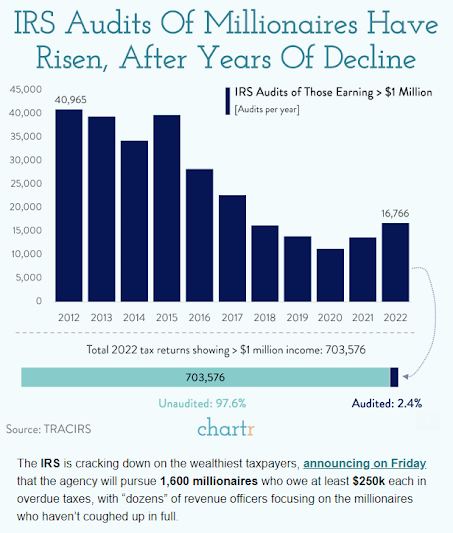
I still feel the need to preface every blog post with the reminder that these blog topic headings are myths, unless I indicate otherwise.  It is certainly a myth that our tax systems are fair.  Read this carefully, though; this chart doesn't show "Millionaires" as the title suggests.  This is individuals and couples who EARN $1,000,000 per year  in taxable income.  The decline shown from 2012 to 2020 occurred while the number of people in this category skyrocketed.

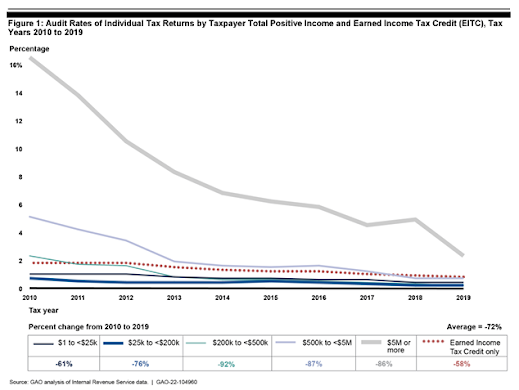
Here's another look at relative audit rates.  The wealthy have enjoyed the greatest decline in audit rates.  And this is primarily due to the reduced IRS funding for which they have lobbied.

So if you don't have an enrolled agent to do your taxes nor a tax law firm to fight IRS in tax court, you are an easier target.  Complex returns are more expensive to audit, especially if they end up in tax court.
We should welcome the Biden administration's increased IRS funding targeting those who owe more than $250,000 in taxes.
But why should we even care?  Well, a social and economic system based on merit and equity is simply a happier way to live and such a society is more likely to survive more than a couple hundred years.  Our ancestors came over here to escape primarily two plagues:  religious persecution, and, a society based on the accumulation of unmerited wealth, usually by inheritance.


Your Constructive Comments are Welcome!

Monday, September 4, 2023

My Chances Are Best If I Just Stay The Course In Retirement

Financial math and actuarial science prove this is a solid myth.  Unless, of course, your retirement financial plan is based on Hope and Luck.  Which, I must admit, sometimes works.  For myself and my clients I prefer more certainty.
A recent whitepaper by financial behemoth BlackRock* indirectly affirms the way Duell Wealth Preservation builds retirement financial plans for our clients.  They emphasize the essential challenge of shifting from the Accumulation Phase to the Distribution phase.  They detail the essential task of optimizing Social Security.  They demonstrate the importance of maintaining a Growth allocation.  Finally, they prove the power of guaranteed lifetime income.  And just with these three elementary planning tactics (out of a lot of others) they conclude one can "potentially generate more retirement income and decrease risk:

    1. Adding guaranteed lifetime income
    combined with a more aggressive asset
    allocation generates 29% more annual
    spending ability from one’s retirement
    savings (excluding Social Security) and
    reduces downside risk by 33%.

    2. On top of that, delaying retirement and
    claiming Social Security benefits from
    65 to 67 boosts total annual spending
    another 16% and reduces downside risk
    by an additional 15%.

    3. The increased spending generated by
    these strategies extends well beyond the
    average life span, providing a significantly
    higher spending floor into a retiree’s 90s
    and beyond.


    *MKTGM0823U/S-3050437-6/8

    Your Constructive Comments are Welcome!

    Tuesday, July 18, 2023

    Bigger is Better


    The "Bigger is Better" myth is a prime example of confirmation bias, that is, seeking, retaining and believing data that supports what we already believe.  We feel more secure dealing with a large and/or well-know financial company, well, because we already do.  I can't fault most members of the public for this because we are not well-trained in gathering relevant evidence, facts that should be the basis for our trust.  This is especially true in the financial world.  I dealt with this on an individual adviser/firm level in this blog:
    https://financialmyths.blogspot.com/2023/03/i-can-trust-licensed-fiduciaries-with.html

    Today's topic is based on a disturbing 3/3/2023 article by Osman Husain in Enzuzo.  I copy it here in its entirety.  I fail to understand why anyone continues to let any of these companies hold their money.  Those are some pretty serious fines!

    Just as in any other industry, the financial industry has its fair share of questionable behavior. Thankfully, regulatory oversight — and accompanying fines for non-compliance, violations, and even fraud — exist to keep financial institutions in line. 

    And the number of fines has reached some staggering levels. Let’s dive into the biggest compliance violations & fines in the past decade. 


    Bank Fines: The 14 Biggest Compliance Fines

    From time to time, some banks get a little too zealous about padding their accounting sheets. When this happens, it can fall under the category of a bank scheme. From outright fraud to behaviors that are far from transparent or ethical, these are some of the biggest regulatory fines in recent history that have been levied against financial institutions domestic and foreign.

    We’ve listed the bank fines from smallest to largest, along with a brief overview of what offending behavior caused a bank to get caught with its hand in the proverbial cookie jar. 


    The AML Program That Wasn’t — $1.256 Billion

    AML is short for anti-money laundering program. In short, banks are expected to uphold business practices and regulations that don’t support financial crimes. However, in 2012, the U.S. Department of Justice (DoJ) found that HSBC Bank USA had an AML program that was nothing more than for show. 

    Instead, the bank tended to look the other way regarding its foreign account holders and associated activities. HSBC was found in violation of the Banking Secrecy Act, Trading with the Enemy Act (TWEA), and the International Emergency Economic Powers Act (IEEPA) after evidence was uncovered of questionable transactions for clients in sanctioned nations like Iran, Cuba, Libya, Sudan, and Burma. 

    HSBC was found liable for aiding in the laundering of at least $881 million in drug-related finances over several years, leading to the $1.256 billion fine. 


    The MAN Group’s Poor Trading Oversight — $1.312 Billion

    Hedge funds aren’t immune to oversight from financial regulators either. The MAN Group is a storied hedge fund with a history that began in 1783 and is one of the largest publicly traded funds in the world. The brokerage division emerged as a separate entity known as MF Global in 2007, and that’s when the problems began. 

    To summarize, the firm was constantly found in violation of trading regulations, poor debt provisions, and even difficulty with maintaining liquidity to cover bad calls. While the company went bankrupt in 2011, the investigations continued into the company and its core directors — including the CEO John Corzine.

    The Commodity Futures Trading Commission (CFTC) was the investigating party. While the company was ordered to pay $1.212 billion to customers from the Federal Court in New York, and a $100 million penalty with the CFTC, individual directors also paid heavy fines. Corzine settled with the CFTC for $5 million and agreed to a lifetime ban from CFTC markets. 


    JPMorgan Chase & the Biggest Ponzi Scheme — $1.7 Billion

    You can’t have a “best of the worst” financial fines list without including Bernie Madoff. He’s known for having pulled off the largest Ponzi scheme in history — defrauding his customers while grossing an estimated $65 billion over several decades. In 2009, when the markets were still reeling from the bursting housing bubble, Madoff was found guilty of fraud and sentenced to 150 years in prison.

    Meanwhile, contributing banking institutions like JPMorgan Chase were also found liable because of poor oversight that allowed Madoff to swindle his victims with impunity. To avoid prosecution, the multinational bank agreed to pay $1.7 billion in restitution to Madoff’s victims. 


    SAC Capital Advisors & Insider Trading — $1.8 Billion

    Yet another hedge fund makes the list with one of the more considerable fines levied for insider trading. Insider trading is when an individual or institution gets advanced information about a publicly traded stock — thereby giving them an unfair advantage over other consumers or commercial traders. SAC Capital Advisors had been under investigation by the Securities and Exchange Commission (SEC) for years but things came to a head in 2013. 

    The New York firm was found guilty of not just insider trading, but wire fraud and securities fraud. Along with a hefty $1.8 billion fine, several individual traders found themselves headed to jail. To date, this is the largest fine for insider trading in U.S. history. Of that amount, half was set aside for criminal fines and the other half for civil fines related to money laundering and forfeiture actions. Another result was the company and its subsidiaries being barred from ever taking any future outside investor funds. 


    Credit Suisse & Tax Fraud — $2.5 Billion

    Wanting to reduce your tax liability is normal. Engaging in deceit to do so is a great way to either see the inside of a jail cell or pay hefty fines. Credit Suisse was under investigation for years because of allegations regarding unscrupulous accounting to aid U.S. customers in falsifying income tax returns and accompanying documents that were submitted to the IRS. 

    However, the bank’s questionable arithmetic wasn’t just limited to the U.S. Taxation. Agencies in other countries including Brazil and Germany also had their eyes on Credit Suisse. In the U.S., the bank was ordered to pay $1.8 billion. However, along with additional fines, the total amounts to $2.5 billion. 


    LIBOR Price-Fixing Scandal — $2.5 Billion

    Price fixing is never a good idea, but sometimes even banks need to be reminded that monopolies are illegal. The LIBOR scandal involves criminal charges regarding a foreign currency exchange that involves several major multinational banks between 2007 and 2013. Citicorp, Barclays PLC, JPMorgan Chase & Co, The Royal Bank of Scotland plc, and UBS AG all pled guilty to felony charges for each member’s involvement in the scheme. 

    Simply put, forex (foreign exchange) traders at the banks worked in tandem to manipulate currency values between the U.S. dollar and the European euro for financial gain. As if this isn’t enough, the traders called themselves “The Cartel” and even initiated private chat rooms and codes to influence exchange rates. 

    Typically, the exchange rates were edited twice daily, at 1:15 PM for the European Central Bank fix, and at 4:00 PM for the World Markets/Reuters fix. The traders would agree to only buy and sell at specific times, ensuring minimal losses for participating member banks. As with many other entries on this list, that $2.5 billion fine isn’t the final word for the exposed institutions.


    Wells Fargo’s Phantom Accounts — $3 Billion

    One of the most recent offenders hits close to home with the American banking corporation, Wells Fargo. Unlike many of the other entries on this list, Wells Fargo gets a mention because the firm repeatedly engaged in illegal activity that’s said to have harmed over 16 million consumer accounts. 

    Highlights from the financial company’s misdeeds include opening up phantom banking and credit accounts and banking services under real customer names without consent. The reason for such misdeeds? The bank demanded high sales quotas from its employees. As a mea culpa, the bank agreed to a $3 billion settlement to the DoJ. However, the Consumer Financial Protection Bureau (CFPB) is still investigating other allegations against Wells Fargo so that figure could increase. 


    Wells Fargo & Rampant Mismanagement — $3.7 Billion

    As you can see, several banks on this list don’t ever seem to learn a lesson, becoming repeat offenders. This time, Wells Fargo returns over additional claims of mismanagement and consumer abuses. The CFPB settled with the bank for $3.7 billion dollars. Allegations included that customer payments were misapplied for mortgages and auto loans. 

    Meanwhile, other consumers were hit with incorrect interest charges. In severe cases, people lost their homes or cars as a result of the bank's errors. Note that this settlement includes a $1.7 billion civil penalty and over $2 billion that will be given directly to customers affected by the bank’s misdeeds. 


    Credit Suisse’s Toxic Asset Sell-Off — $5.3 Billion

    Balancing your books is one thing. But knowing that your business practices are going to contribute to a massive economic crisis — and trying to stave off the damage before it happens — is criminal. Several banks found themselves on the wrong side of the law after the Subprime Mortgage Crisis (SMC), including Credit Suisse. 

    Institutions determined to significantly influence activities that ushered in the Great Depression, later learned in the following decade that those behaviors wouldn’t go unpunished. Credit Suisse was ordered to settle in the amount of $5.3 billion for selling toxic debts before the financial crisis took hold. Roughly $2.48 billion of this figure was paid as a civil penalty with $2.1 billion used for consumer relief. 

    However, this is just one part of the fallout from the SMC as almost every major bank across the U.S. and many multinationals also faced steep fines for poor oversight and intentionally providing loans to unsuitable customers. 


    Goldman Sachs & the Pilfered Malaysian Coffers — $5.4 Billion

    No one likes a thief. But if you steal from government funds, don’t be surprised when the long arm of the law finds you. Goldman Sachs found itself in hot water in 2020 for participating in the Malaysian 1MDB scandal. The event refers to millions that were stolen from the state investment fund. 

    While the masterminds behind the scandal were local Malaysian government officials and accomplices, Goldman Sachs was accused of facilitating money laundering to divert money from the state fund. To avoid further investigation and legal action, the bank agreed to pay a total of $5.4 billion to multiple global regulators including the DoJ in the U.S. Additionally, the bank paid another $1.4 billion to Malaysia as part of a restitution settlement. 


    Deutsche Bank & SMC — $7.2 Billion 

    Shoddy business practices that prioritize profit over sound actions will always catch up with you in the end. Deutsche Bank, a massive multinational bank headquartered in Germany, can attest to this as the financial institution was slapped with a $7.2 billion fine in 2016 for attempting to offload toxic assets ahead of the housing crash. Of that figure, roughly $4.1 billion is being set aside for consumer relief and loan modifications that will be spread out over the next five years. 


    BNP Paribas’ Money Laundering — $8.973 Billion

    Smart individuals and businesses know that trying to scheme around anti-terrorism laws is a bad idea. However, BNP Paribas, a French-based bank, apparently failed to get that memo. The bank was found in violation of both the IEEPA and TWEA in 2015 for processing billions of transactions through the U.S. financial system on behalf of sanctioned nations. 

    BNP Paribas was accused of “deliberately disregarding the law” according to the DoJ, working to cover its tracks in the process, while helping to support terrorism in countries such as Sudan, Iran, and Cuba. The bank was required to fork over $8.833 billion to the U.S. government as well as pay $140 million in fines, which gets you the $8.973 billion total. 


    JPMorgan Chase & SMC — $13 Billion

    The subprime mortgage crisis had a lot of dirty banking hands in the cookie jar. So, while many banks faced fines, some were slapped with significantly higher ones. JPMorgan Chase found itself in the hot seat both for federal and civil claims because it participated in passing out poorly vetted mortgages to consumers. The bank agreed to settle for $13 billion in 2013 with the DoJ. 

    However, this bank wasn’t alone. You may remember that JPMorgan faced its day of reckoning along with the investment bank Bear Stearns and Washington Mutual. However, the two latter firms no longer exist. Both went defunct in 2008, with JPMorgan Chase opting to purchase them — which raised several red flags. Washington Mutual was absorbed into the Chase Bank brand while Bear Stearns was acquired under the investments division.  


    Bank of America & SMC — $30.6 Billion

    If there’s a biggest loser for “most fines paid” from the SMC scandal, it’s Bank of America (BoA). Yes, several banks paid a lot of money for their involvement in activities that destabilized the global economy. But, BoA has faced the most fines during this period. BoA found itself agreeing to multiple settlements over the past decade to atone for its questionable practices. 

    The bank paid $11 billion as part of the $25 billion agreement with the five largest mortgage servicers in the U.S. This was meant to address previous foreclosure and loan servicing abuses. But then, the bank paid $10.3 billion to Fannie Mae as part of a settlement in 2013. Again, in 2014, BoA paid $9.3 billion in a settlement with the Federal Housing Finance Agency. 


    Compliance is Crucial

    This “best of the worst” list highlights a critical reality, non-compliance can cost you. Likewise, just because you get away with questionable behavior initially, doesn’t mean that regulators or government agencies won’t eventually come knocking on your door. In most of the cases we highlighted, financial institutions were engaged in clearly criminal or at least unethical activities that they knew were problematic. 

    But many business owners don’t always know the minutiae of privacy laws. Having a simple solution that can help your website maintain compliance can save you serious headaches in the future. Enzuzo is a software-as-a-service (SaaS) solution designed to keep your business compliant so you can focus on your key product offerings and daily activities. 


    Your Constructive Comments are Welcome!